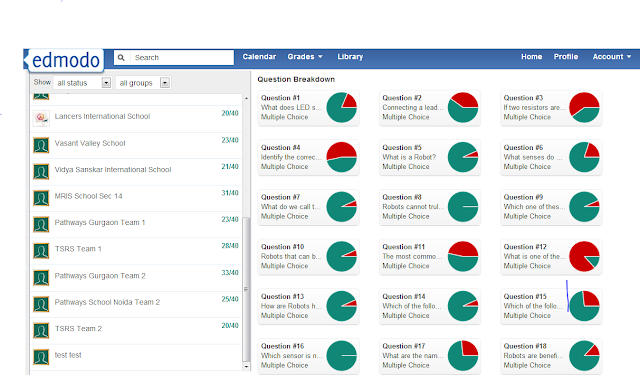
The day ended with an online quiz on Edmodo. Each team was allotted a laptop. They were given thirty minutes to take the quiz.
There were forty questions and each one was based on the discussions that happened today.
Wednesday, 26 September 2012
LDR House
The LDR House
Mr Andrew began on the next project for the teams, the ‘Lighthouse’, an LDR paper house in which the LED lights switch on when the house is kept in the dark and automatically switches off, when placed in a well lit area. Mr Andrew went on to explain about circuits and how, even though most circuits are usually in a plastic case, this one would be in the paper case, which is the ‘house’. He went on to explain all the components in the circuit: the battery clip which is the power source; the resistor which would slow down the current; the light-emitting diode (the LED) which gives off light; the transistor which basically is the amplifier; the light dependent resistor which limits the current like a resistor but only works according to the amount of light falling on it (this would enable the light to turn on and off according to the brightness/darkness; and if that was enough, there were the simple wires! Mr Andrew explained that the red ones were to be connected to the positive terminal of a battery and the black to the negative. It WOULD be a problem if you messed that up! These were all the components of the circuit. Imagine how many would be in a high-definition, widescreen television! There were instructions distributed to each table and the excitement in the atmosphere doubled. Eager hands reached for the papers and fingers curled around components. Everyone was excited to start building!
This was not a competitive event, however we must commend the American Embassy School Team for being the first to complete the construction of LDR house. Well Done!!!
Mr Andrew began on the next project for the teams, the ‘Lighthouse’, an LDR paper house in which the LED lights switch on when the house is kept in the dark and automatically switches off, when placed in a well lit area. Mr Andrew went on to explain about circuits and how, even though most circuits are usually in a plastic case, this one would be in the paper case, which is the ‘house’. He went on to explain all the components in the circuit: the battery clip which is the power source; the resistor which would slow down the current; the light-emitting diode (the LED) which gives off light; the transistor which basically is the amplifier; the light dependent resistor which limits the current like a resistor but only works according to the amount of light falling on it (this would enable the light to turn on and off according to the brightness/darkness; and if that was enough, there were the simple wires! Mr Andrew explained that the red ones were to be connected to the positive terminal of a battery and the black to the negative. It WOULD be a problem if you messed that up! These were all the components of the circuit. Imagine how many would be in a high-definition, widescreen television! There were instructions distributed to each table and the excitement in the atmosphere doubled. Eager hands reached for the papers and fingers curled around components. Everyone was excited to start building!
This was not a competitive event, however we must commend the American Embassy School Team for being the first to complete the construction of LDR house. Well Done!!!
Soldering by Mr. Andrew Mcloughlin
Mr. Andrew made a power point presentation
on soldering. He began by explaining about LDR’s. He went on to inform the
participants about the proper safety measures to follow while using the
soldering iron. After the teams were briefed, they were allowed to open the
boxes that contained the materials used, to make a stick figure. They had to
cut a wire into six equal pieces and turn the soldering iron on. The iron took
five to ten minutes to heat up so they had to prepare other materials. The ends
of each strip had to be stripped off using a wire stripper. After the ends were
bare, the participants used the soldering iron to weld the wires together.
Next, the students bent and twisted the wires into stick figures.
Sensors Presentation done by Shivani Roy
Shivani Roy, HOD ICT of Pathways Senior
School, Gurgaon made a presentation on sensors.
She started by explaining a little about sensors and what types of
sensors there are, such as thermal sensors and mechanical sensors. Thereafter she described the kinds of sensors
that are used in the Lego Mindstorm kits, the ultrasonic sensor, the light
sensor and so on. After the
presentation, all the teams received one or two tablets to try out a few
games. Everyone got a dose of fun, and I
spotted a few trying out a few other games as well… The IPads were grudgingly let go, for a quick
five-minute contest of who could name the most sensors. The "spot the sensor" contest was a tie between Pathways Noida and Amity Gurgaon. Both teams spotted nine sensors
Key Note Address by Mr Neeraj Gulati
Mr Gulati started off his speech by
thanking Mrs Narang, Mrs Sharma and Mr Andrew for inviting him to the Second Annual
Robongiers fest, at Pathways School, Gurgaon. He admitted that he loved
schools, as they were his favorite place to be.
He stood as a representative for the ‘Tod
Fod Jod’ Initiative, of the Prime Minister’s National Innovation Council. The
name,’Tod Fod Jod’, means to deconstruct (break), reconstruct (repair) and
recreate (bring together and innovate into a new product). He spoke of his mentor,
Sam Pitroda, who brought in the Telecommunication Revolution to India. He spoke
with a lot of reverence about this innovator, entrepreneur, policy maker with a
hundred plus US patents. He also spoke of Samir Mitra, a man who is committed
to India and has never failed any of his projects.
He continued onto the topic, “Why Youth
Innovation?” Given the fact that 60% of
the country is under 30 years, the demographic dividend is the youth; hence the
focus on schools!
He spoke of the NIC creating a platform, a
National Eco-System for schools, for re-tooling them from mere learning, to
application based systems. This would make us a Nation of Creators and not just
Consumers!!
He spoke about how we have unique
constraints that impact both business and society. He talked about the pros and
cons of the business and society as well; how certain ways of doing things work,
while others don’t, and how we can sell the good ideas to other developing
countries, like Vietnam, Egypt etc. Thus we can capitalize on the export
opportunities, while solving domestic problems. He then continued that how knowledge
does not make creators and that practical application is the need of the hour.
It takes a long time to create he said, as we build on the ideas of a billion
different people. Reverse Innovation will change the world, he exclaimed with
great passion.
He believes strongly that curiosity is the
mother of creativity for curiosity makes us explore. ‘Tod Fod Jod’s’ objective
is to create a network in which children across the world could connect,
collaborate, and discover.
He gave us some samples of the things ‘Tod Fod
Jod’ has worked on, such as a dryer, refrigerator, Tube Light, toilets,
toasters, cell phones, cameras, computers and a many others. He has visited under-
privileged schools also and video-graphed some TPJ moments. He showed some more videos of highly
accomplished kids, e.g. a 19 year old teenager named Adam Cudworth, who sent up a camera in a balloon high into the atmosphere which photographed the curvature of the earth; 16 your old Arts student Samarth Kirloskar, from Pune, whose
interest in aeronautics has helped him create a model plane, that flies and has won him the 1st Prize in the Aeromodelling Competition held at IIT Kanpur, at the Annual Tech Fest (Tech kriti). This is
just an example of all of the amazing things student can create with the help
of ‘Tod Fod Jod’…
Subscribe to:
Posts (Atom)